

Run your team with clarity, not guesswork.
Everyone knows where they need to be. Every time. TailPro’s Team Management gives you full visibility over staff schedules, availability and assignments in one central place, so nobody’s relying on memory or a group chat to know what’s happening today.
Staff profiles, shift scheduling, leave tracking and booking assignments, all in one system that updates itself the moment anything changes.
No credit card required · Free plan, forever · Included on every TailPro plan
How Team Management improves daily operations
What you actually get
As your business grows, coordinating staff manually gets harder, miscommunication, double assignments and unclear responsibilities start creating stress and mistakes that didn’t exist when it was just you and one or two staff.
| Feature | What it means for you |
|---|---|
| Staff profiles & permissions | Every team member has their own record, with the access that’s right for their role |
| Shift scheduling tools | Build and manage shifts directly in TailPro, not in a separate rota |
| Leave & availability tracking | Time off and availability live in the same system as your bookings |
| Booking assignments | Assign bookings to the right staff member based on their actual schedule and role |
| Clear team overview dashboard | See your whole team’s day at a glance, not pieced together from messages |
All of it updates automatically when something changes, you’re not maintaining a schedule and a separate reality that drifts apart from it.
From setup to a team that runs itself
Set the structure once. Coordination stops being a job.
You set the structure once, staff profiles, availability, roles. From there, day-to-day coordination stops being something you have to actively manage.
- 1You create staff profiles – with the role, permissions and availability that fit each team member.
- 2Availability and shifts are defined in TailPro – not tracked separately from your bookings.
- 3Bookings are assigned to the right person – based on who’s actually scheduled and available.
- 4Changes update the system automatically – a shift swap or a new booking, and everyone’s view stays current.
- 5Every staff member sees a clear, accurate picture – where they need to be and what they’re responsible for, without asking.
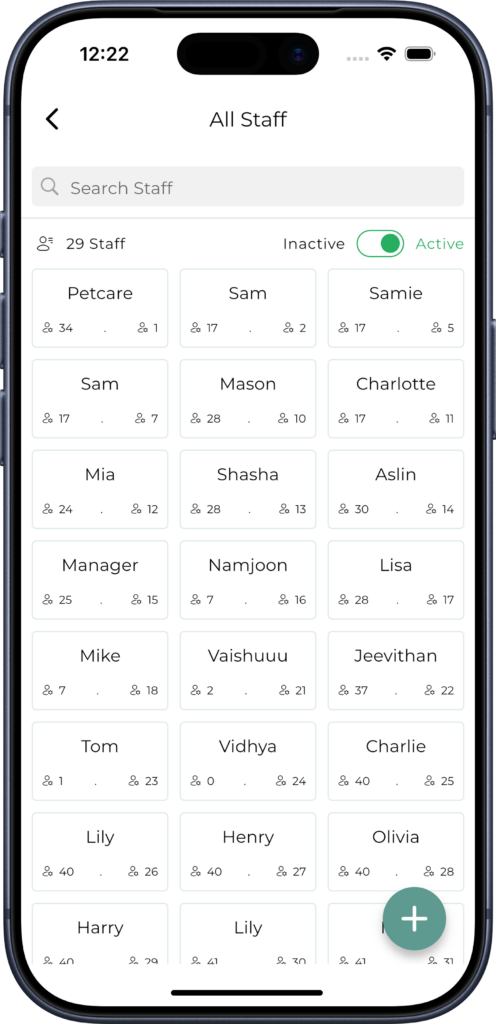
Nobody’s checking a group chat to confirm what’s happening, the system already knows, and so does everyone using it.
Why not just coordinate informally?
What works for two people breaks down at ten
Group messages and verbal handovers rely on everyone paying attention, remembering instructions, and manually updating each other when something changes. That works fine with a small team, and gets fragile fast as you add more people, more shifts, and more bookings to track. Team Management replaces that informal process with a structured, always-current team overview. Staff know their responsibilities. Managers keep oversight without having to chase it. Clients get consistent service, because the right person always knows what they’re doing.
Informal coordination
- Relies on everyone remembering and updating each other
- Gets fragile as your team grows
- Miscommunication leads to missed assignments
- Managers chase updates instead of leading
Team Management
- One structured, always-current overview
- Scales cleanly as you add staff
- Every assignment recorded, no ambiguity
- Managers keep oversight without chasing it
Time Saved
No chasing updates or repeating instructions across a group chat.
Fewer Mistakes
No double-bookings, no assignments going to someone who isn’t working.
Real Accountability
Every assignment is recorded, so there’s no ambiguity about who’s responsible for what.
Scales With Your Team
The more staff you add, the more informal coordination breaks down, this doesn’t.
Not a rota spreadsheet: staff availability, shifts and assignments live inside TailPro itself, connected directly to the bookings they affect.
Set up your team once
Every future shift and assignment runs from the same accurate picture.
Team Management FAQs
FAQs
Lead your team with confidence, not constant coordination.
Stop chasing updates and repeating instructions. Give your team one clear, always-current source of truth for who’s doing what, and lead with confidence instead of guesswork.